Essential Design Resources for Food Technology Professionals
For professionals in the food science, agri-tech, and nutritional sectors, communicating complex processes and data clearly is a constant challenge. Marketing teams, research departments, and product developers often need to create presentations, reports, brochures, and digital content that are both technically accurate and visually engaging. This is where specialized design templates become a critical resource, saving time while ensuring a professional and cohesive visual identity.
What Is the Food Technologies Brochure Template Set?
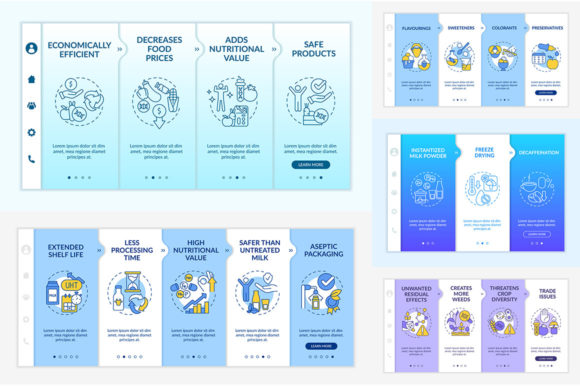
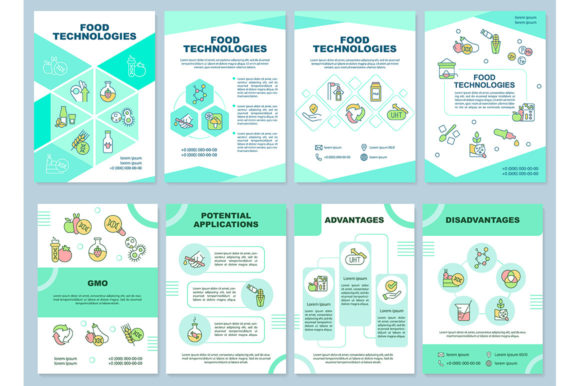
The Food Technologies Brochure Template Set is a curated collection of digital design assets specifically created for the food technology industry. It goes beyond a simple brochure layout. The core offering includes a set of four distinct vector layouts suitable for presentations, annual reports, technical leaflets, and promotional brochures. These layouts are designed with a clean, modern aesthetic, utilizing linear icons and a structured information hierarchy.
The template set employs two specific fonts: Arial Black for strong headings and Myriad Pro Regular for body text. This combination offers a balance of impact and readability. Importantly, the product provides files in multiple formats—EPS, SVG, PNG, JPEG, and AI—giving designers flexibility whether they are working in Adobe Illustrator, using web-based tools that accept SVG, or needing ready-to-use image files for quick implementation.
What makes it distinct is its industry-specific focus. The included linear icons and infographic elements are tailored to represent common food technology concepts, such as processing techniques, quality control cycles, supply chain steps, and nutritional data visualization. This removes the need to adapt generic business icons, which often fail to convey sector-specific nuances.
Evaluating Design Resource Options
When considering design resources, professionals typically evaluate several categories: fully custom design services, generic multipurpose templates, and niche industry-specific templates like this set. Each path has different tradeoffs in terms of cost, time, and final output.
Custom design services offer the highest degree of personalization and uniqueness but come with significant cost and time investment. They are a strong fit for large-scale, ongoing branding projects but may be impractical for a single report or an internal presentation needing a quick turnaround.
Generic template marketplaces offer vast libraries at low cost. However, finding assets that accurately reflect food technology processes—like extrusion, fermentation, or pasteurization—can be difficult. The result often requires considerable modification, which can defeat the purpose of using a template for efficiency.
The Food Technologies Brochure Template Set sits in a middle ground. It provides a degree of specificity that reduces adaptation work, while its structured layouts and format variety offer a quicker path to a polished final product than building from absolute scratch. Its value is in its contextual relevance.
Strengths and Practical Applications
The primary strength of this template set is its contextual efficiency. A food safety officer preparing a leaflet on new HACCP protocols could use the linear icons to visually map steps from raw material intake to finished product storage. A startup in alternative proteins could utilize the report layouts to present fermentation yield data to investors in a clear, professional format.
The inclusion of vector formats (AI, EPS, SVG) is a significant advantage for professionals who need to scale graphics without quality loss or edit colors and shapes to match their existing brand guidelines. The PNG and JPEG outputs serve those who need to integrate elements directly into PowerPoint or web pages without specialized software.
Realistic use cases include:
- Creating a consistent visual theme across a series of technical workshop presentations.
- Developing an annual R&D report that requires blending text, data charts, and process diagrams.
- Designing a consumer-facing brochure that explains a novel food processing technology in simple, visual steps.
- Building screen layouts for an internal mobile app that tracks production line metrics.
The set’s structure encourages information clarity, which is paramount when explaining technical subjects to diverse audiences, from scientists to regulators to consumers.
Limitations and Decision Factors
While the Food Technologies Brochure Template Set addresses a specific need, it is not a universal solution. Understanding its boundaries is key to making an informed choice.
One consideration is brand flexibility. The templates come with a predefined font pairing and a linear icon style. If your organization's brand identity strictly requires a different typeface (e.g., Garamond or a custom font) or uses a filled, illustrative icon style, integrating this set would require more extensive alteration. In such cases, a more malleable generic template or a custom approach might be a better starting point.
Another factor is scope of need. The set is focused on print and presentation materials—brochures, leaflets, reports. If your primary requirement is for animated video graphics, interactive web components, or extensive social media assets, this package provides a foundational visual style but not the animated or interactive files themselves. It would be a complementary resource rather than a complete one.
The decision often hinges on the balance between specificity and customization. For a team that needs to produce professional, industry-relevant materials quickly and has a brand that can accommodate the template’s aesthetic, this set is a highly efficient choice. For a project demanding full, unique brand expression from the ground up or requiring digital formats beyond static graphics, exploring other options is advisable.
When It’s the Right Fit
The Food Technologies Brochure Template Set may be the right choice in several common scenarios:
- When internal design resources are limited and efficiency is paramount.
- When communicating to audiences that benefit from clear, standardized visual representations of technical processes.
- When starting a new project or initiative that lacks established visual materials but needs a professional look quickly.
- When working across multiple document types (presentation, report, leaflet) that need to feel cohesively part of the same project.
It serves as a practical toolkit to elevate communication without the overhead of a full design project.
Navigating Ongoing Design Needs
The creators of the Food Technologies Brochure Template Set, BSD Studio, indicate they expand their offerings with new topics and discounts weekly. They also create icons, brochure infographic templates, and mobile app screen pages. For professionals whose needs evolve, subscribing to such a studio can be a way to stay updated on new assets that might fit future projects.
This approach contrasts with one-time purchases. A subscription or ongoing relationship with a specialized provider can ensure access to updated and expanding resources that remain relevant as your communication challenges change. However, it requires evaluating the long-term value and frequency of new, useful content versus the cost.
The key is to assess whether your design needs are project-specific and occasional, or ongoing and varied. For occasional needs, a single purchased set like this one could suffice. For teams that regularly produce technical marketing, educational, or reporting materials in the food sector, a broader resource pool or subscription might offer more sustained support.
Ultimately, selecting any design resource is about aligning its capabilities with your practical constraints: time, budget, brand requirements, and audience expectations. The Food Technologies Brochure Template Set offers a targeted solution for a common industry challenge. By providing pre-structured layouts and relevant icons in multiple file formats, it reduces the barrier to producing clear, professional materials. For those whose situation matches its strengths, it can be a sensible investment in communication efficiency. For others, understanding its focus and limitations simply helps clarify what to look for in alternative resources, ensuring that whatever path is chosen leads to a final product that effectively bridges the gap between complex food technology and its intended audience.